Dead Man's Dump: Create Your Own Edition
Stage III: Create your own edition
You have now had an opportunity to look at all manuscripts and typescripts, and should have reached a decision on which one is to be your base manuscript. Your task now is to create the edition itself.
Before you start, use the above tabs to:
- Familiarise yourself with transcription notation
- Read through our brief example edition
Use the below manuscripts, this time with their diplomatic transcripts alongside, to create an edition. You should start with the transcript of your base manuscript and then make appropriate edits, ensuring to note the different manuscript variations at the bottom, to create an edition of the poem you think suits best.
When looking at the manuscripts you think MS B is the ‘base manuscript’ the nearest to the final version the poet managed. Select MS B and on the right hand panel you will see a diplomatic transcription where everything on the manuscript is recorded. Copy and paste the text into a word-processor. Now, using the methods outlined in ‘Diplomatic Transcripts’ and ‘Example Edition’ work through the other manuscripts – starting with MS A – and record down any things that are different (‘variants’). Think of the following questions:
- Does any of it make you question your choice of base manuscript?
- Piecing it together can you suggest an order in which the manuscripts were written?
- What does it tell you about the poet and how they wrote a poem, how much thought they put into words and phrases?
- What did they change and why?
When you are finished working through all the manuscripts and recording the variants you will have created your own edition of this famous poem! You can then scroll below to compare to the published edition.
Browse Diplomatic Transcripts of 'Dead Man's Dump'
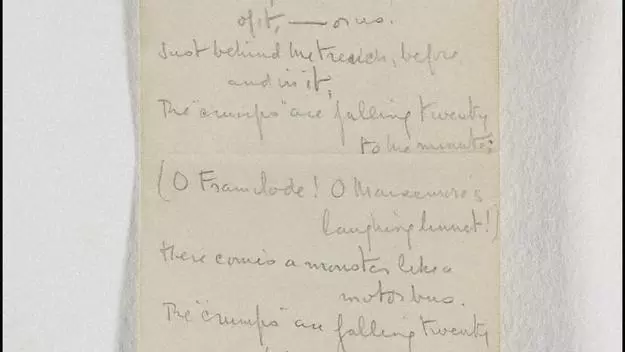
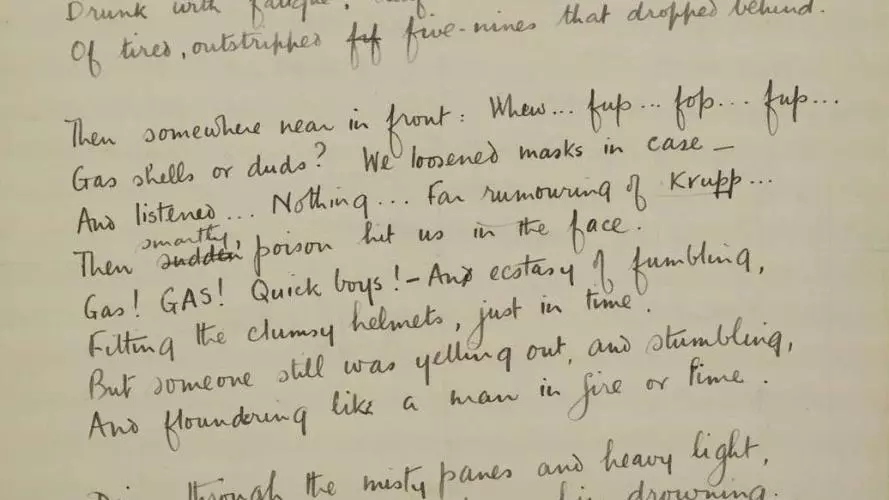
| 2 omitted cancelled by I.R. [Now let the seasons know There are some less to feed of them, That winter need not hoard her snow, Nor autumn her fruits & grain. - What fierce imaginings their dark souls lit Earth! have they gone into you? Somewhere they must have gone, And flung on your hard back Is their soul's sack Emptied of all that made it more than the world In its small fleshly compass. Who hurled them out? Who hurled? \variant alteration by I. R.\ None saw their spirits shadow shake the grass, Or stood aside for the half used life to pass Out of those doomed nostrils & the doomed mouth, |
jQuery(function() { if (!$.fn.imagezoomsl) { $('.msg').show(); return; } else $('.msg').hide(); // plugin initialization $('.magnify').imagezoomsl({ innerzoommagnifier: true, classmagnifier: "round-loope", magnifiersize: [200, 200], // disables the scrolling of the document with the mouse wheel when the cursor is over the image disablewheel: false }); });
Stage IV: Compare your Edition
You can now compare your edition with the published one that appears in Vivien Noakes's (ed.) The Poems and Plays of Isaac Rosenberg (OUP, 2004), pp. 139-142 (with notes pp. 367-9). Noakes observes that 'No complete MS has been traced' and she elects to choose the typescript MSF (correctly IR/I/263-4) as her base. Clearly she views this as the latest typescript (the fourth one).
DEAD MAN'S DUMP
The plunging limbers over the shattered track
Racketed with their rusty freight,
Stuck out like many crowns of thorns,
And the rusty stakes like sceptres old
To stay the flood of brutish men
Upon our brothers dear.
The wheels lurched over sprawled dead
But pained them not, though their bones crunched,
Their shut mouths made no moan,
They lie there huddled, friend and foeman,
Man born of man, and born of woman,
And shells go crying over them
From night till night and now.
Earth has waited for them
All the time of their growth
Fretting for their decay:
Now she has them at last!
In the strength of their strength
Suspended - stopped and held.
What fierce imaginings their dark souls lit
Earth! have they gone into you?
Somewhere they must have gone,
And flung on your hard back
Is their soul's sack,
Emptied of God-ancestralled essences.
Who hurled them out? Who hurled?
None saw their spirits' shadow shake the grass,
Or stood aside for the half used life to pass
Out of those doomed nostrils and the doomed mouth,
When the swift iron burning bee
Drained the wild honey of their youth.
What of us, who flung on the shrieking pyre,
Walk, our usual thoughts untouched,
Our lucky limbs as on ichor fed,
Immortal seeming ever?
Perhaps when the flames beat loud on us,
A fear may choke in our veins
And the startled blood may stop.
The air is loud with death,
The dark air spurts with fire
The explosions ceaseless are.
Timelessly now, some minutes past,
These dead strode time with vigorous life,
Till the shrapnel called 'an end!'
But not to all. In bleeding pangs
Some borne on stretchers dreamed of home,
Dear things, war-blotted from their hearts.
A man's brains splattered on
A stretcher-bearer's face;
His shook shoulders slipped their load,
But when they bent to look again
The drowning soul was sunk too deep
For human tenderness.
They left this dead with the older dead,
Stretched at the cross roads.
Burnt black by strange decay
Their sinister faces lie
The lid over each eye,
The grass and coloured clay
More motion have than they,
Joined to the great sunk silences.
Here is one not long dead;
His dark hearing caught our far wheels,
And the choked soul stretched weak hands
To reach the living word the far wheels said,
The blood-dazed intelligence beating for light,
Crying through the suspense of the far torturing wheels
Swift for the end to break,
Or the wheels to break,
Cried as the tide of the world broke over his sight.
Will they come? Will they ever come?
Even as the mixed hoofs of the mules,
The quivering-bellied mules,
And the rushing wheels all mixed
With his tortured upturned sight,
So we crashed round the bend,
We heard his weak scream,
We heard his very last sound,
And our wheels grazed his dead face.