Dulce Et Decorum Est: Create Your Edition
You have now had an opportunity to look at all manuscripts and typescripts, and should have reached a decision on which one is to be your base manuscript. Your task now is to create the edition itself.
Before you start, use the above tabs to:
- Familiarise yourself with transcription notation
- Read through our brief example edition
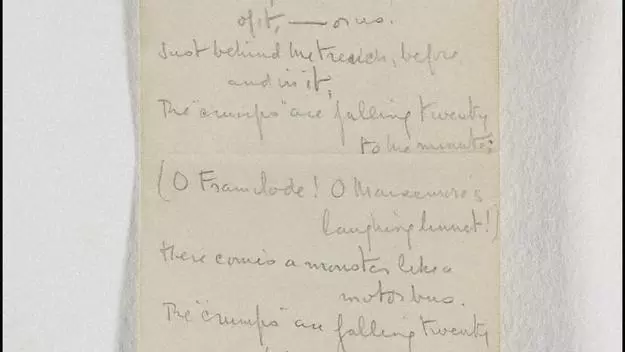
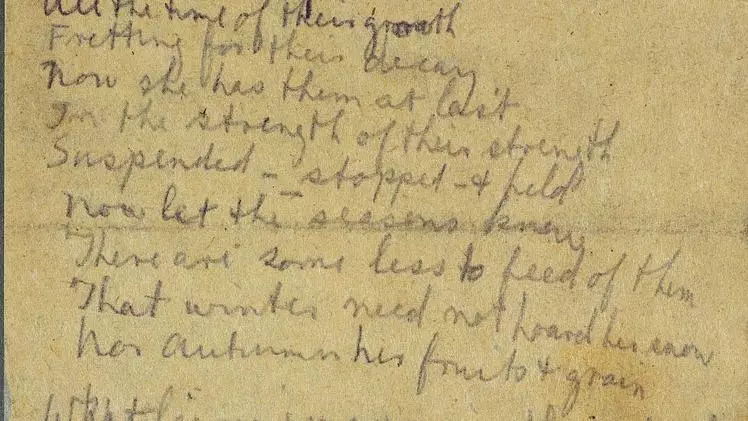
Use the below manuscripts, this time with their diplomatic transcripts alongside, to create an edition. You should start with the transcript of your base manuscript and then make appropriate edits, ensuring to note the different manuscript variations at the bottom, to create an edition of the poem you think suits best.
When looking at the manuscripts you think MS B is the ‘base manuscript’ the nearest to the final version the poet managed. Select MS B and on the right hand panel you will see a diplomatic transcription where everything on the manuscript is recorded. Copy and paste the text into a word-processor. Now, using the methods outlined in ‘Diplomatic Transcripts’ and ‘Example Edition’ work through the other manuscripts – starting with MS A – and record down any things that are different (‘variants’). Think of the following questions:
- Does any of it make you question your choice of base manuscript?
- Piecing it together can you suggest an order in which the manuscripts were written?
- What does it tell you about the poet and how they wrote a poem, how much thought they put into words and phrases?
- What did they change and why?
When you are finished working through all the manuscripts and recording the variants you will have created your own edition of this famous poem! You can then scroll below to compare to the published edition.
Browse Diplomatic Transcripts of 'Dulce et Decorum est'
|
|
Dulce et Decorum est. [To a certain Poetess] Bent double, like old beggars under sacks,
Then somewhere near in front: Whew... fup... fop... fup...
Dim, through the misty panes and heavy light,
In all your dreams if you could slowly pace
Wilfred Owen |
jQuery(function() { if (!$.fn.imagezoomsl) { $('.msg').show(); return; } else $('.msg').hide(); // plugin initialization $('.magnify').imagezoomsl({ innerzoommagnifier: true, classmagnifier: "round-loope", magnifiersize: [200, 200], // disables the scrolling of the document with the mouse wheel when the cursor is over the image disablewheel: false }); });
Compare your Edition
You can now compare your edition with a published one (Stallworthy, 1983) and read some information about the manuscripts and the decisions Stallworthy made in creating his edition.
DULCE ET DECORUM EST
Bent double, like old beggars under sacks,
Knock-kneed, coughing like hags, we cursed through sludge,
Till on the haunting flares we turned our backs
And towards our distant rest began to trudge.
Men marched asleep. Many had lost their boots
But limped on, blood-shod. All went lame; all blind;
Drunk with fatigue; deaf even to the hoots
Of tired, outstripped Five-Nines that dropped behind.
Gas! GAS! Quick, boys! - An ecstasy of fumbling,
Fitting the clumsy helmets just in time;
But someone still was yelling out and stumbling,
And flound'ring like a man in fire or lime . . .
Dim, through the misty panes and thick green light,
As under a green sea, I saw him drowning.
In all my dreams, before my helpless sight,
He plunges at me, guttering, choking, drowning.
If in some smothering dreams you too could pace
Behind the wagon that we flung him in,
And watch the white eyes writhing in his face,
His hanging face, like a devil's sick of sin;
If you could hear, at every jolt, the blood
Come gargling from the froth-corrupted lungs,
Obscene as cancer, bitter as the cud
Of vile, incurable sores on innocent tongues, -
My friend, you would not tell with such high zest
To children ardent for some desperate glory,
The old Lie: Dulce et decorum est
Pro patria mori.
(p.140)