
Ivor Gurney
'Little did I dream, England, that you bore me / Under the Cotswold hills beside the water meadows, / To do you dreadful service, here, beyond your borders / And your enfolding seas.'
Strange Service
Biography
Ivor Gurney (1890-1937)
Ivor Gurney was born in Gloucester on 28th August 1890, the son of David and Florence Gurney, a family of tailors. Gloucester, and the surrounding countryside, were to be a major influence on the rest of his life, constantly drawing him back. He was educated at the King's School in Gloucester Cathedral as a chorister and organist, and his love of music was to be one of the dominating influences of his life. In 1911 he studied at the Royal College of Music under Sir Charles Stanford.
Gurney tried to enlist at the outbreak of war, but was rejected due to poor eyesight (he wore glasses throughout most of his life). He eventually joined on the 9th February, 1915, as a private with the 2nd/5th Gloucesters. He was injured in early 1917, and later during the Battle of Passchendaele (Third Ypres) he was caught in a gas attack and invalided home.
Whilst on active service Gurney, removed from the tools and peace required to allow him to work on his music, began to concentrate on his poetry. Not only did he write his own poems, he also commented on the works of other contemporary poets. He corresponded with his friend Marion Scott throughout, who assisted in getting his poems ready for print, and many of the manuscripts and typescripts provide evidence of this. In 1917 Severn and Somme was published, and then a further collection in 1919 - War's Embers. The titles of the two collections are important and prophetic. First, as is demonstrated in many of his war poems, his love of the Gloucestershire countryside and his desire to return there from the devastation he witnessed on the Western Front is constantly evident. Second, the war would have a lasting effect on Gurney up until his death, and even in his later poems he refers to his experiences there.
These two slim volumes, however, only tell a small part of the story. In the Gurney archive at the Gloucestershire Archives are numerous other drafts of poems, many unpublished, and an indication of the sheer range of his work became evident in editions by Edmund Blunden (1954) and Leonard Clark (1973), but particularly with the publication of his Collected Poems (edited by P. K. Kavanagh, 1982) which included c. 300 texts. Interest in Gurney has grown considerably over the years with the appearance of his War Letters and Collected Letters (1983 and 1991, edited by R. K. R. Thornton), further editions of his poetry, and detailed studies of his musical output. With reference to the latter, two collections of his songs - Ludlow and Teme (1923) and The Western Playland (1926) - demonstrated early on his talent, followed by a further collection in 1938, and several others after World War Two. In 1995, the Ivor Gurney Society was set up with the aim of furthering the study and promotion of his work. Moreover, a major initiative is currently underway at the Archives to re-catalogue the full collection and produce new editions of Gurney's works.
Gurney was a musician and a poet, who combined his skills at song writing and wordplay. Yet throughout his life he was a troubled man, and he even attempted suicide in 1918. Many people have assumed, therefore, that Gurney was a victim of shell-hock or 'neurasthenia' but it is generally accepted now that his illness predates the War, and his experiences there, and notably his injuries from gas might have worsened his condition (it has also been argued this may relate to a failed relationship with a nurse in 1918). At the same time, the ordered life provided by the Army may have provided him with a period of longed for stability. After he returned from war service he attempted to pick up his studies at the Royal College of Music, but found it too difficult. His behaviour became more extreme and in 1922 he was was sent to Barnwood House Asylum in Gloucester, then moving to the City of London Mental Hospital remaining there until his death.
From 1932 onwards he was visited regularly by Helen Thomas, wife of Edward Thomas. The two conversed about the love of the Gloucestershire countryside that Ivor and Edward shared, and Gurney's admiration of the latter's verse. Helen Thomas described their initial meeting at the hospital:
'we were met by a tall gaunt dishevelled man clad in pyjamas and dressing gown, to whom Miss Scott introduced me. He gazed with an intense stare into my face and took me silently by the hand. Then I gave him the flowers which he took with the same deeply moving intensity and silence. He then said, 'You are Helen, Edward's wife and Edward is dead.' And I said, 'Yes, let us talk of him.' (H. Thomas, Time and Again: Memoirs and Letters, ed. M. Thomas, 1978, pp. 11-112.)
Ivor Gurney died on 26th December 1937 in the City of London Mental Hospital from Tuberculosis.
| Author | Stuart Lee |
|---|---|
| Sources |
|
The Ivor Gurney Collection
User Guide for the First World War Poetry Digital Archive on Oxford University's SDS Platform
The SDS (Sustainable Digital Scholarship) platform, powered by FigShare, is a robust digital repository used by Oxford University to host a wide range of academic content. It ensures long-term preservation and accessibility of scholarly resources. This user guide will help you navigate the First World War Poetry Digital Archive stored within this platform.
Navigating the Archive
-
Select a Category below: Begin by choosing a category from the available tabs below, such as poetry, correspondence, etc. This selection will link you to specific types of documents within the archive.
-
Accessing Items: Once you click on an item, a new tab will open in your browser directing you to the SDS page containing the selected record. If there are multiple versions of an record, such as a manuscript and a typescript of a poem, the link might direct you to a search result page on SDS where all versions are listed.
-
Example of the page directly to the record:
Image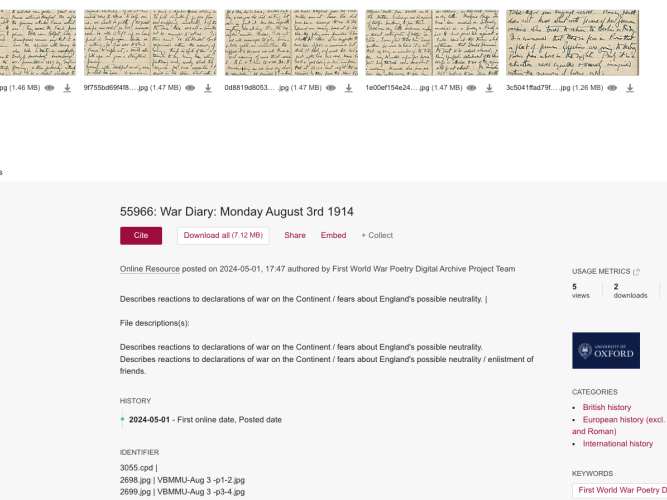
-
Example of the page when there are multiple versions of a record:
Image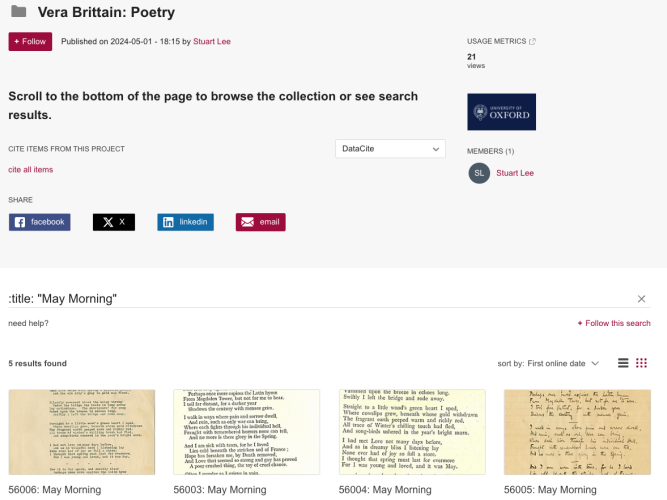
-
-
Browsing Collections: Besides specific searches, you can also browse the entire collections on the SDS platform. This feature allows you to explore additional materials that may not be directly linked to but are part of the First World War Poetry Digital Archive.
Please Note:
- Accessibility: Archive files from recent years are accessible using assistive technologies. Older files, particularly those scanned from original printed volumes, may not be fully accessible and are recommended to be downloaded for optimal viewing.
- Access Restrictions: Some documents, especially those containing sensitive information, are only available to university members through a single sign-on account. Publicly available files can be accessed without such restrictions, adhering to data protection guidelines.
- Assistance Requests: For specific access needs or inquiries, such as obtaining content in accessible formats or accessing restricted files without a single sign-on, please contact the appropriate administrative support via email.
Citing and Downloading Records
- To cite an item, click the 'Cite' button under the item's title in SDS. See below:
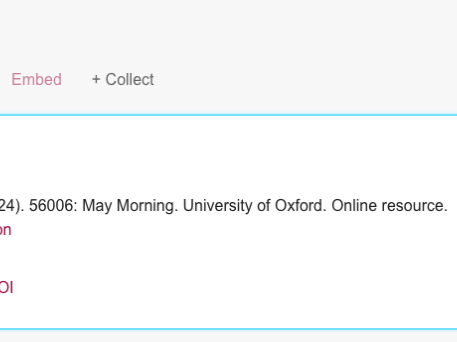
- Download Options: You can download files directly from the SDS platform. This is recommended for large files or when a detailed review of documents is required.