Intro to WW1 Poetry
WW1 Poetry and 'Injury'
[This seminar was originally published in 1998].
This seminar is intended as an introduction to First World War poetry. In order to provide a focus for this seminar, all of the 'featured' poems have been selected for their appropriateness to a given theme. The theme selected is that of injury and the physical, mental and other consequences of this.
You should begin by reading the small essays below introducing you to war poetry and questions surrounding the topic, and then visit the pages on the poets themselves (at the foot of the page or through the side bar on the left).
The Poems
In most cases each poet or topic includes the following:
- An introduction to the poet/topic
- A featured poem, appropriate to the seminar's theme
- Some literary criticism of the featured poem
- Other relevant information or texts
- A selection of other poems appropriate to the poet/topic [any poem marked with +Notes will have more details]
What is 'War Poetry'?
Without doubt this question is central to this series of seminars on the poets of the First World War, and worth confronting from the beginning. Jon Stallworthy, in his introduction to The Oxford Book of War Poetry (1984) begins by evoking the emotive force of the poems in his anthology:
"'POETRY', Wordsworth reminds us, 'is the spontaneous overflow of powerful feelings', and there can be no area of human experience that has generated a wider range of powerful feelings than war: hope and fear; exhilaration and humiliation; hatred - not only for the enemy, but also for generals, politicians, and war-profiteers; love - for fellow soldiers, for women and children left behind, for country (often) and cause (occasionally)." (p.xix)
Yet, though unquestionably accurate, this does little to help define 'War Poetry'. Loss of a loved one through natural causes, or the accidental discovery of a picturesque field of daffodils can generate a wide 'range of powerful feelings', yet such poems would not have found their way into Stallworthy's anthology.
War Poetry could be described as being:
a) Poems which concentrate on the subject of war; or
b) Poems which are written during a war that seems to have a noticeable influence on the poet.
Of these two, 'a' would be widely accepted by most as a standard definition of the genre, and is clearly the raison d'etre behind Stallworthy's collection. To include poems under the category of 'b' is more troublesome. It would be hard to envision any circumstances under which the 1914–1918 conflict failed to have an influence on anyone living in Britain at the time, yet to include Wilfred Owen's love poems from the period before he enlisted in a collection of War Poetry would be unusual (though Stallworthy (1994) in his War Poems collection does include poems written by Owen before he enlisted, but only ones which deal with the subject of war.
The seminars contained in this Web site reflect definition 'a'.
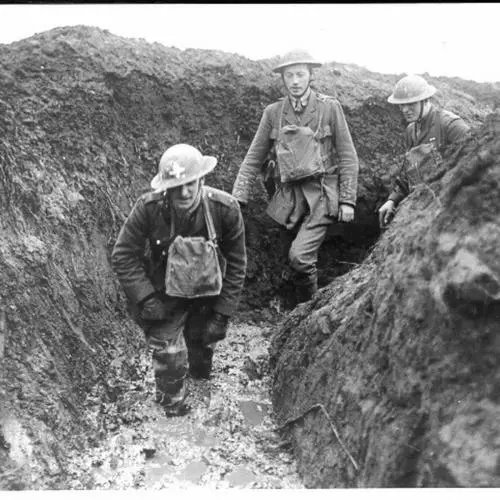
The central focus of these seminars is one war in particular: namely the First World War, or The Great War, fought over the period August 1914 - November 1918. Although this was fought in many theatres, and in a number of continents, the poets detailed here are drawn predominantly from British soldiers serving on the Western Front, i.e. the almost continuous series of trenches running through Belgium and France that formed the front line between the Allied and German armies. It was on this front that some of the most important (and bloodiest) battles of the War were fought (though that is not to discount the importance of such battles as Tannenberg and Caporetto or the horrendous cost of the failed Gallipoli campaign) - a list which includes such fields of slaughter as: Mons, Loos, Ypres, the Somme, Verdun, and Passchendaele.