
Wilfred Owen
'My subject is War, and the pity of War. The Poetry is in the pity.'
Preface
Biography
Wilfred Owen (1893-1918)
Wilfred Edward Salter Owen was born to Thomas and Susan Owen on the 18th of March 1893 near Oswestry, Shropshire. Upon the death of Owens's grandfather in 1897, the Owen family were forced to move from the house he had owned in Oswestry to lodgings in Birkenhead (1898), Merseyside, and it was in the Birkenhead Institute that Owen's education began. In 1907, when Thomas Owen was appointed Assistant Superintendent of the London and North Western and Great Western Joint Railways, the family moved to Shrewsbury where Owen's education continued at the Shrewsbury Borough Technical School. Upon leaving school at 18 Owen spent a period of months working as a pupil-teacher at Wyle Cop School. In the autumn he passed the matriculation examination for the University of London but without the first class honours needed to gain a scholarship. Unable to afford to study, he worked as lay assistant to the Vicar of Dunsden near Reading. In his spare time he also attended University College, Reading, and is known to have studied the diverse subjects of botany and poetry. Between 1913 and 1915 Owen travelled to Bordeaux, France, and taught at the Berlitz School of English. He was actually tutoring in the Pyrenees when war was declared.
Increasingly aware of the scale of the War, Owen returned to England in autumn 1915 and enlisted in the Artists' Rifles. His training was completed in Hare Hall Camp in Essex, but this allowed him time to make trips to London, notably to the Poetry Bookshop run by Harold Monro who he met. On 4th June 1916 Owen was commissioned as a second lieutenant with the Manchester Regiment. In the last days of 1916 he was posted to France. In January 1917 he and his men held a flooded dugout for fifty hours under heavy bombardment. In March, he suffered concussion and spent time in hospital. In April he returned to the front again, only to be caught up in fierce fighting. At one point he was hit by a shell blast at Savy Wood, and lay semi-conscious in a shell crater with the dismembered remains of a friend. On the 30th April whilst on parade he was noted as being 'shaky' and on 1st May he was diagnosed as suffering from shell-shock ('neurasthenia') and evacuated to England.
After a medical examination Owen was sent to Craiglockhart War Hospital in Edinburgh. There he met Siegfried Sassoon, also a patient and already a noted poet. Owen was to gain immeasurably from the friendship which developed between them. Sassoon's poetic voice, with its strong emphasis on realism, influenced Owen's developing style, as the poems 'Dulce et Decorum Est' and 'Anthem for Doomed Youth' demonstrate. This realism and emphasis on experience also played a part in Owens's therapy in Craiglockhart where Arthur Brock, Owens's doctor, encouraged him to translate the experiences he had suffered into poetry. Sassoon both edited and vigorously promoted his work, and brought him into a wider literary circle. An introduction to Robert Graves (a friend of Sassoon's) led to further meetings with, amongst others, Arnold Bennett and H. G. Wells. As he recovered, Owen worked for a short time as a teacher in Tynecastle High School, before returning to light regimental duties, first at Scarborough, then Ripon. It was at Ripon that Owen 'seemed to have composed or revised virtually all his war poems' (Hibberd, 2002, p. 389).
In June 1918 the twenty-five year old officer rejoined his regiment at Scarborough and in August was again posted to France. He was awarded the Military Cross (posthumously) for his leadership and bravery during the attack on Joncourt on the 1st October, storming enemy points and turning a German unit's own machine gun against them. On the 4th of November 1918, leading an attack by the Sambre Canal, near Ors, Owen was killed in action. The news of Owen's death reached his family on Armistice Day.
Owen's poetry was promoted and published by Sassoon after his death, and backed by Edith Sitwell, a proponent of innovative trends in English poetry. In 1931 Edmund Blunden's anthology of Owens's work sent his reputation soaring to new heights, and today Owen is regarded as one of the most talented poets of the period. He is buried at Ors communal cemetery in France.
| Author | Stephanie Fishwick. Edited by Stuart Lee |
|---|---|
| Sources |
|
The Wilfred Owen Collection
User Guide for the First World War Poetry Digital Archive on Oxford University's SDS Platform
The SDS (Sustainable Digital Scholarship) platform, powered by FigShare, is a robust digital repository used by Oxford University to host a wide range of academic content. It ensures long-term preservation and accessibility of scholarly resources. This user guide will help you navigate the First World War Poetry Digital Archive stored within this platform.
Navigating the Archive
-
Select a Category below: Begin by choosing a category from the available tabs below, such as poetry, correspondence, etc. This selection will link you to specific types of documents within the archive.
-
Accessing Items: Once you click on an item, a new tab will open in your browser directing you to the SDS page containing the selected record. If there are multiple versions of an record, such as a manuscript and a typescript of a poem, the link might direct you to a search result page on SDS where all versions are listed.
-
Example of the page directly to the record:
Image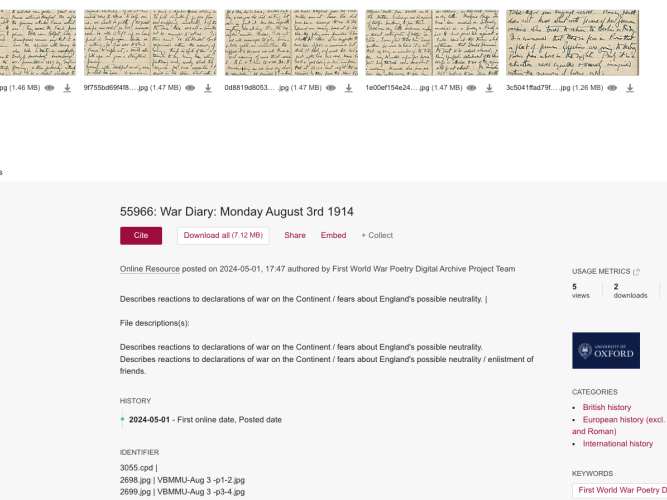
-
Example of the page when there are multiple versions of a record:
Image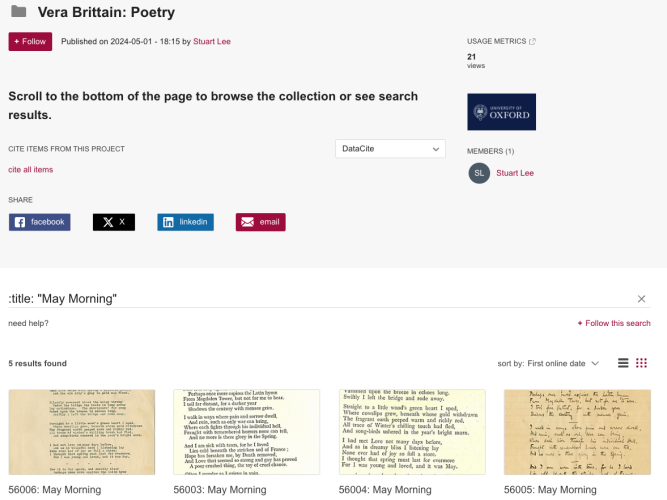
-
-
Browsing Collections: Besides specific searches, you can also browse the entire collections on the SDS platform. This feature allows you to explore additional materials that may not be directly linked to but are part of the First World War Poetry Digital Archive.
Please Note:
- Accessibility: Archive files from recent years are accessible using assistive technologies. Older files, particularly those scanned from original printed volumes, may not be fully accessible and are recommended to be downloaded for optimal viewing.
- Access Restrictions: Some documents, especially those containing sensitive information, are only available to university members through a single sign-on account. Publicly available files can be accessed without such restrictions, adhering to data protection guidelines.
- Assistance Requests: For specific access needs or inquiries, such as obtaining content in accessible formats or accessing restricted files without a single sign-on, please contact the appropriate administrative support via email.
Citing and Downloading Records
- To cite an item, click the 'Cite' button under the item's title in SDS. See below:
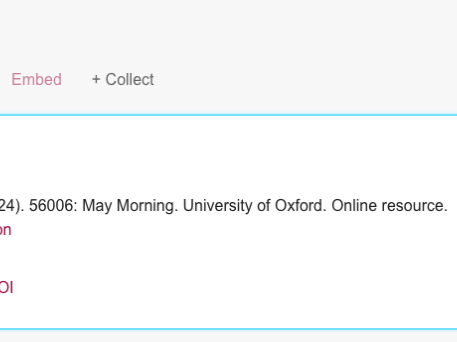
- Download Options: You can download files directly from the SDS platform. This is recommended for large files or when a detailed review of documents is required.